You can check out this Erbium Doped Fiber Laser (EDFL) tech — it’s really shaking things up in lots of areas, especially in telecoms and medicine. Dr. Emily Carter from FiberOptic Innovations put it nicely when she said, “EDFL systems have totally changed how we handle high-speed data transfer.” Her words highlight just how big of an impact this technology is having.
As industries rely more and more on quick, reliable communication and precise tools, the perks of EDFL become pretty obvious. One major plus is how efficient it is—this kind of laser uses way less power than the older, traditional ones. Plus, the wavelength of EDFL is just right for boosting signals in fiber optics. That means less signal loss over long distances, which is a huge deal for today’s telecom networks.
But it’s not all smooth sailing. Manufacturing these systems can be pretty expensive, which means smaller companies might find it hard to get their hands on them. And, honestly, the tech is complex—it needs very precise engineering and a good amount of expertise to get right. In the end, understanding both the strengths and the limitations of Erbium Doped Fiber Laser tech can really open the door to more innovation and progress in this exciting area.
Overview of Erbium Doped Fiber Laser Technology
Erbium Doped Fiber Laser Technology is gaining attention in various fields. This innovative approach utilizes erbium ions in optical fibers to generate laser light. The result is a more efficient and versatile laser system. The output wavelength usually lands around 1550 nm. This wavelength is ideal for telecommunications due to low loss in fiber optics.
One significant benefit is the high efficiencyof Erbium Doped Fiber Lasers. They convert electrical energy into light with minimal waste. This can lead to reduced operational costs. An area for improvement lies in the complexity of the system. The technology requires precise control and calibration. Improper adjustments can impact performance.
Another key aspect is the ability to amplify signals. This is crucial for long-distance communications. Erbium Doped Fiber Amplifiers enhance signal strength without adding noise. However, managing these systems can be challenging. They need careful monitoring to ensure consistent output. Overall, while the advantages are clear, some technical challenges persist.
Applications of Erbium Doped Fiber Lasers in Telecommunications
Erbium Doped Fiber Lasers (EDF) have transformed telecommunications. These lasers utilize Erbium Doped Optical Fiber to amplify light signals over long distances. This is critical for fiber optic communication systems. According to a report by MarketsandMarkets, the global fiber optics market is projected to reach $7 billion by 2025. The efficiency of EDF technology drives this growth.
In telecommunications, Erbium Doped Optical Fiber enables higher data rates. It supports dense wavelength division multiplexing (DWDM). This technique allows multiple signals to travel simultaneously. It is estimated that fiber networks using EDF can support data rates exceeding 100 Gbps. This is essential as the demand for bandwidth continues to rise.
However, challenges still exist. The performance of Erbium Doped Fiber Lasers can degrade over time. This leads to increased signal loss and reduced efficiency. Operators must continuously monitor and maintain their systems. Additionally, the initial cost of deploying these sophisticated lasers can be daunting for some companies. Balancing cost and performance remains a significant concern in the industry.
Advantages of Enhanced Signal Quality with Erbium Lasers
Erbium-doped fiber lasers (EDFLs) significantly enhance signal quality in optical communication. They are known for their ability to amplify light efficiently. Reports indicate that EDFLs can boost signal strength by up to 20 dB. This increase is crucial for long-distance data transmission. With better signal quality, networks can achieve lower error rates.
Furthermore, EDFLs operate in the 1550 nm wavelength region. This is where optical fibers have minimal loss. Studies show that fiber losses drop below 0.2 dB/km at this wavelength. As a result, companies can save on infrastructure costs. However, the technology must be monitored closely. Too much amplification may lead to signal distortion. This is an area where further research is necessary.
One striking feature of EDFLs is their high efficiency. Some systems achieve efficiencies above 60%. This is impressive compared to traditional lasers. However, environmental factors can impact performance. Temperature fluctuations can affect output. Continuous assessment is needed to mitigate potential challenges.
Cost Efficiency and Energy Savings from Fiber Laser Technology
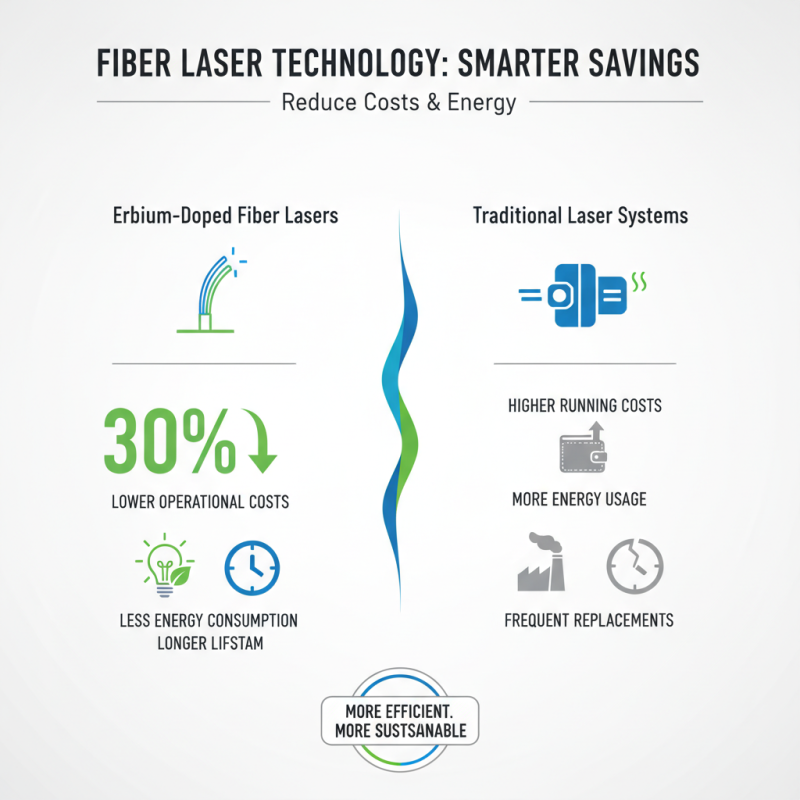
Erbium Doped Fiber Laser Technology is gaining traction for its cost efficiency and energy savings. Recent industry reports suggest that fiber lasers can reduce operational costs by up to 30% compared to traditional laser systems. This is largely due to their lower energy consumption and longer lifespan, which minimizes the need for frequent replacements.
In terms of energy savings, Erbium Doped Fiber Amplifier systems exhibit remarkable efficiency. These systems convert electrical energy to optical energy with minimal losses. A study indicated that upgrading to fiber laser technology could decrease energy usage by 50% in many applications. This is crucial for businesses aiming to reduce their carbon footprint while maintaining productivity.
Tips: When considering a transition to fiber laser technology, assess your current energy costs. Calculate potential savings based on your operational needs. Analyze upfront costs against long-term savings. Remember, the initial investment may be higher, but the benefits often outweigh the costs. Always keep in mind that proper maintenance can further enhance the performance and efficiency of your Erbium Doped Fiber Amplifier, leading to more significant energy conservation over time.
Improved Precision in Material Processing Using Erbium Lasers
Erbium doped fiber laser technology shines in precision material processing. The improved accuracy it offers is significant. This technology allows for sharper cuts and finer details. Industries like manufacturing and medical are keen to adopt it. Using an Edfa Erbium Doped Fiber Amplifier enhances laser performance. This amplification leads to better energy management. It empowers operators to handle complex tasks with ease.
When working with materials, details matter. Traditional methods may leave rough edges. However, erbium lasers create smoother finishes. The heat generated is localized. This minimizes damage to surrounding areas. Precision is especially critical in medical procedures. A slight error can impact patient outcomes. The precision of erbium lasers can help reduce these risks.
It is important to reflect on the limitations. Not every material responds well to erbium lasers. Some thick metals or composites may require adjustments. Training and understanding of the technology are vital. Operators must learn the intricacies of their tools. Fine-tuning settings can lead to better results. Embracing innovation is crucial, but caution is needed in practice.
Comparison of Erbium Doped Fiber Lasers with Other Laser Technologies
Erbium doped fiber lasers (EDFLs) have emerged as a significant technology in the laser industry. They stand out when compared to other laser technologies, particularly in telecommunications. According to a recent report from ResearchAndMarkets, the global fiber laser market is expected to grow at a CAGR of 11.7% from 2021 to 2026. This growth highlights the increasing demand for efficient and powerful laser solutions.
EDFLs offer unique advantages over traditional solid-state lasers. Their wavelength, typically around 1550 nm, is optimal for communication systems. This wavelength minimizes signal loss in optical fibers, making EDFLs ideal for long-distance transmission. Unlike other laser types, they are compact and easy to integrate into existing systems. However, EDFLs can be limited by thermal issues. Maintaining proper cooling becomes essential, or performance may decline.
The flexibility of EDFLs sets them apart from semiconductor lasers. They can be configured for various applications, offering tunability that others cannot match. Still, this adaptability comes with challenges. Systems must be carefully calibrated to achieve desired outcomes. In some cases, achieving the expected efficiency may require ongoing adjustments. While EDFLs present numerous benefits, understanding their limitations is crucial for optimal use in diverse applications.
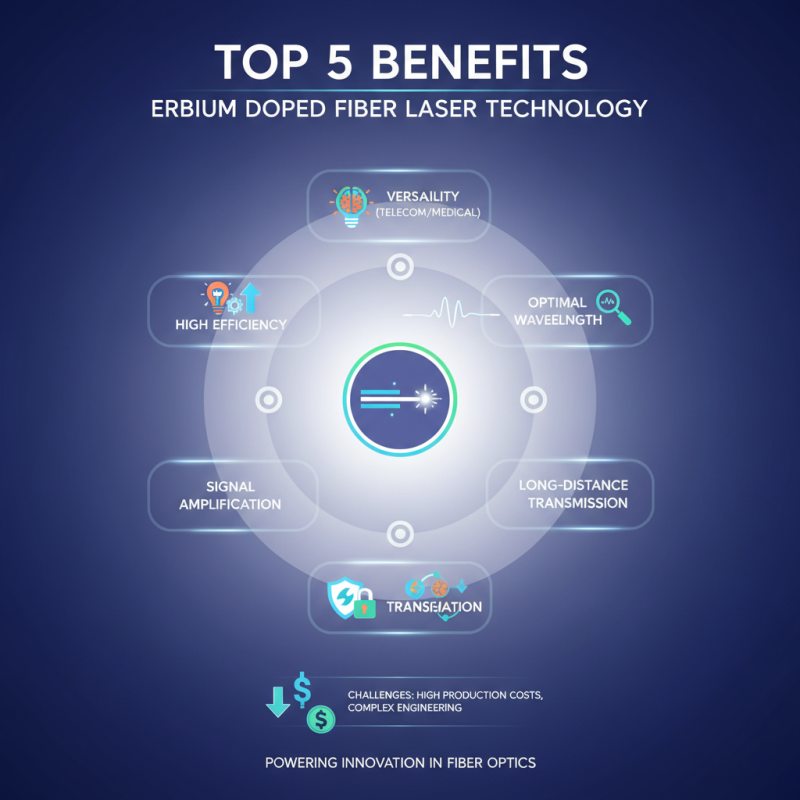
Top 5 Benefits of Erbium Doped Fiber Laser Technology
Future Trends and Innovations in Erbium Doped Fiber Lasers
Erbium doped fiber lasers (EDFLs) are at the forefront of optical technology. Their versatility opens doors to various applications. In telecommunications, EDFLs enhance signal amplification. They support high bandwidths, improving data transmission rates significantly. As technology advances, we see continuous innovations in this field.
Future trends indicate a growing interest in miniaturization. Smaller, more efficient EDFLs could revolutionize portable devices. This shift might lead to improved fiber optics in healthcare too. Laser surgeries could become more precise with advanced EDFLs. On the other hand, challenges remain. Manufacturing processes need improvement to reduce costs and improve yields.
Sustainability is also a concern. The eco-impact of laser production must be evaluated. Innovations in materials and processes might help address this issue. As we move forward, the balance between performance and environmental considerations will be crucial. Embracing innovation while being mindful of its effects is essential for the future of EDFLs.
Exploring the Benefits and Applications of SOA Semiconductor Fiber Optical Amplifiers in Modern Communication Systems
In the rapidly evolving landscape of modern communication systems, Semiconductor Optical Amplifiers (SOAs) have emerged as critical components, particularly in fiber optic networks. These amplifiers offer several remarkable benefits, including low noise operation and reduced power consumption, making them ideal for applications that demand high performance without overwhelming energy costs. With output power reaching up to 10 dBm and a gain of 14 dB, SOAs ensure robust signal integrity, serving essential roles in both metropolitan and long-haul fiber optic communications.
Moreover, the versatility of SOAs is reflected in their array configurations, available in both 1x and 2x formats, allowing system designers to tailor solutions to specific deployment needs. The inclusion of three operational modes—Automatic Power Control (APC), Automatic Gain Control (AGC), and Automatic Current Control (ACC)—further enhances their adaptability, enabling seamless integration into diverse network architectures. This customizable approach to design empowers operators to optimize performance based on varying transmission distances and environmental conditions, solidifying SOAs as indispensable tools in advancing the capabilities of contemporary communication infrastructures.
FAQS
: The article focuses on the impact of technology in everyday life.
It can make communication easier but sometimes leads to isolation.
Yes, it offers convenience and access to information.
It can create distractions and affect mental health negatively.
It provides resources for learning but may reduce attention spans.
Yes, many people rely too heavily on devices for daily tasks.
Reflect on how it shapes habits and relationships with others.
Finding balance is challenging but crucial for well-being.
It blurs boundaries, making it hard to disconnect.
Set limits on screen time and prioritize face-to-face interactions.
Conclusion
Erbium Doped Fiber Laser technology offers several significant benefits, making it a pivotal tool in various fields, particularly telecommunications. One of the primary advantages is its ability to enhance signal quality, leading to clearer and more reliable communication. Additionally, this technology is cost-efficient, providing substantial energy savings compared to traditional laser systems. The precision provided by Erbium Doped Fiber Lasers in material processing significantly improves outcomes in manufacturing processes.
Moreover, when compared to other laser technologies, Erbium Doped Fiber Lasers demonstrate superior performance in terms of efficiency and versatility. The potential for future innovations in this area promises even greater advancements, positioning these lasers at the forefront of technological evolution. Overall, the integration of Erbium Doped Fiber Lasers represents a transformative step in both telecommunications and material processing sectors.

 Fiber Amplifier Products
 Light Source&Light Harvesting Products
 Optical Device Products
 Subsystem Products
 Instruments and Meters
 Communication Field
 Sensing Field
 Laser Radar
 Research and Medical Care